
Research
Near-Earth Asteroid Detection for Planetary Defense
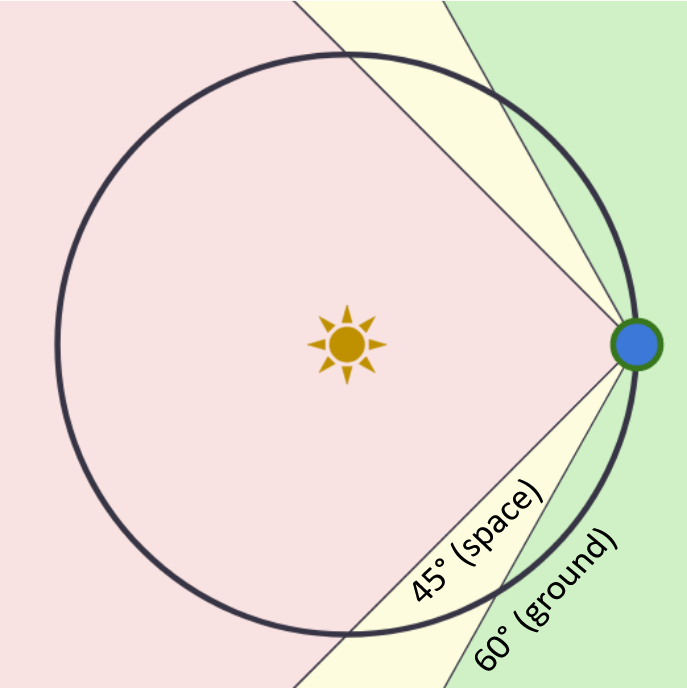
I’m interested in how space-based telescopes could help close gaps in the detection and characterization of Near-Earth Asteroids (NEAs), particularly those which pose an impact risk. Upcoming surveys with Rubin Observatory and the NEO Surveyor Satellite will drastically increase the NEA discovery rate, leading to a strain on existing follow-up resources for characterization. In particular, NEO Surveyor expects to discover asteroids as close as 45 degrees away from the sun, posing challenges for ground-based follow-up instruments which contend with sunlight in Earth’s atmosphere during dusk and dawn. Near-sun observations are important for observing asteroids interior to Earth’s orbit, as illustrated by the lefthand figure.
My doctoral research involves simulating detections of NEAs to determine how a new space-based telescope could complement large surveys by following up on their new asteroid discoveries. Preliminary results from this work were presented at the 2025 IEEE Aerospace Conference (Vlahakis et al., 2025).
Currently, I am working on expanding on the potential relationship between this telescopen and NEO Surveyor by incorporating simulation results from the NEO Surveyor science team.
Past Research Projects:
On-Orbit Adaptive Optics Experiments with the DeMi CubeSat
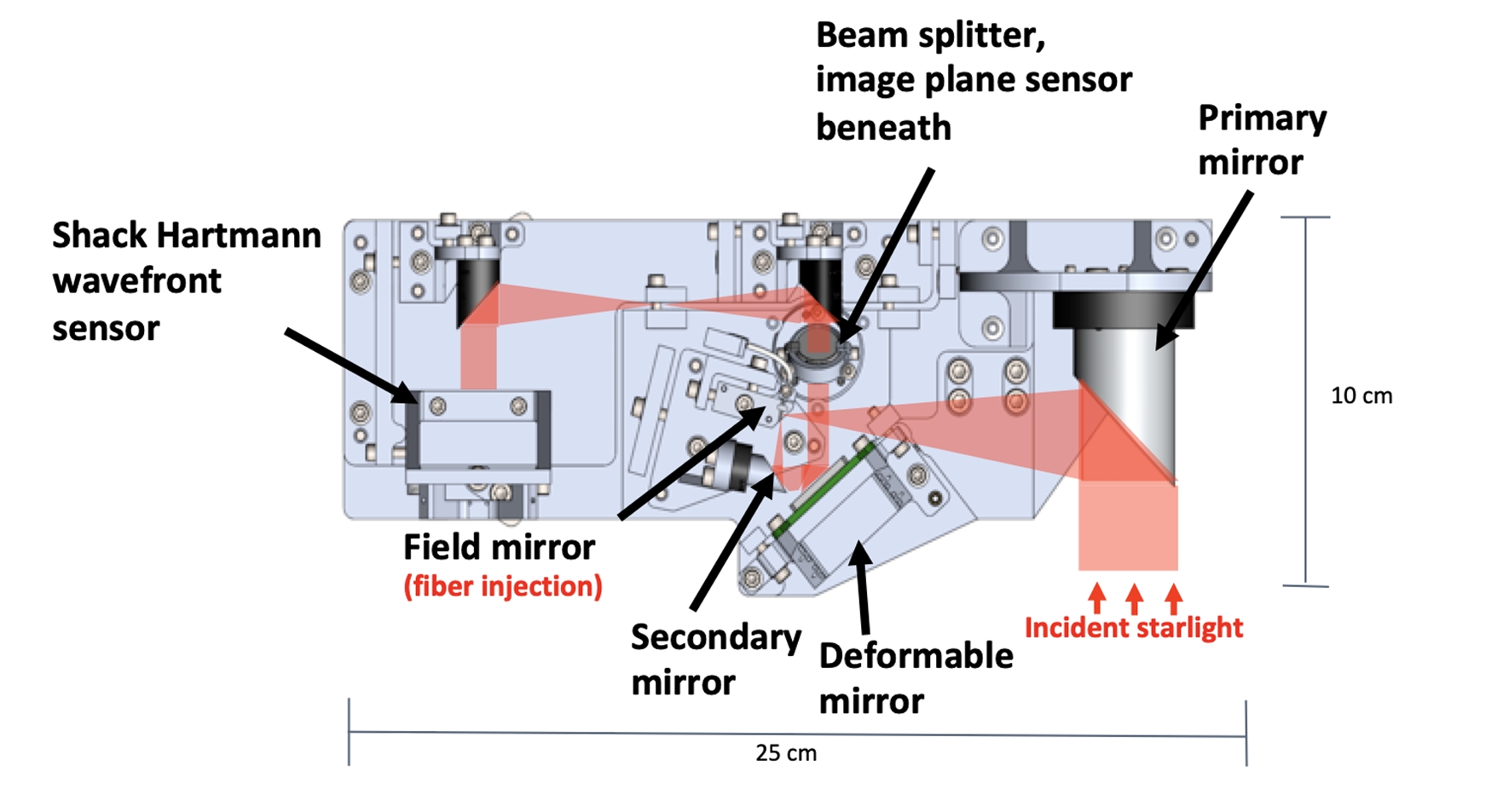
The Deformable Mirror Demonstration Mission (DeMi) CubeSat operated from July 2020 to March 2022 and demonstrated the successful operation of a Microelectromechanical Systems (MEMS) Deformable Mirror (DM) on orbit for the first time. As part of space-borne adaptive optics systems, DMs correct optical aberrations and speckles due to mechanical, thermal, and optical effects. This technology has a wide range of applications, including exoplanet direct imaging with coronagraphs. The lefthand image shows a diagram of the DeMi optical payload (Morgan et al., 2021).
As part of my Master’s thesis, I analyzed data from on-orbit experiment measuring the deflection of individual actuators on the DM using a Shack-Hartmann wavefront sensor. This analysis showed that the DeMi mission successfully measured on-orbit actuator deflection to a precision of 12 nm for input voltages up to approximately 100 V, consistent with the performance during ground testing.
I presented this work at the 2022 Small Satellite Conference (Vlahakis, 2025), earning a 3rd place award in the Frank J. Redd Student Research Competition.
Planet-Matching for Directly-Imaged Exoplanet Systems
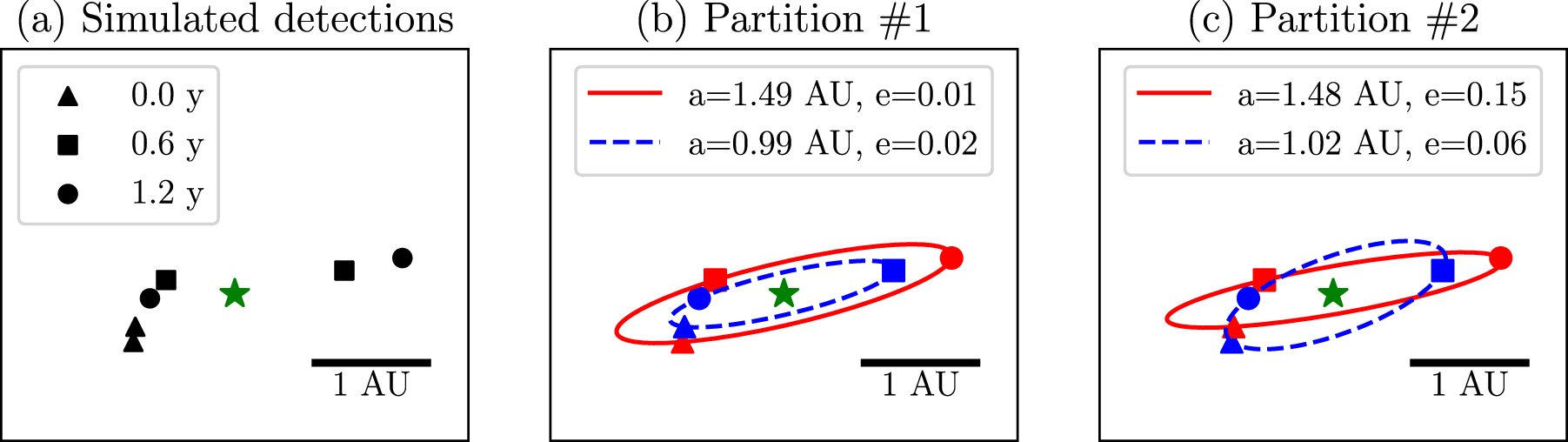
When directly imaging exoplanetary systems with multiple planets, it can be unclear which detection belongs to which planet across different snapshots in time. This research project studied the prevalance of this problem, and describes a tool (the deconfuser) developed to reduce the rate of confusion, with applications for future missions such as the Roman Space telescope and Habitable Worlds Observatory. In this work, I helped develop and test an early version of the deconfusion algorithm and studied how this confusion problem could be mitigated with different observation scheduling strategies.
This work was presented at an SPIE conference (Morgan et al., 2021) and published in The Astrophysical Journal (Pogorelyuk et al., 2022).